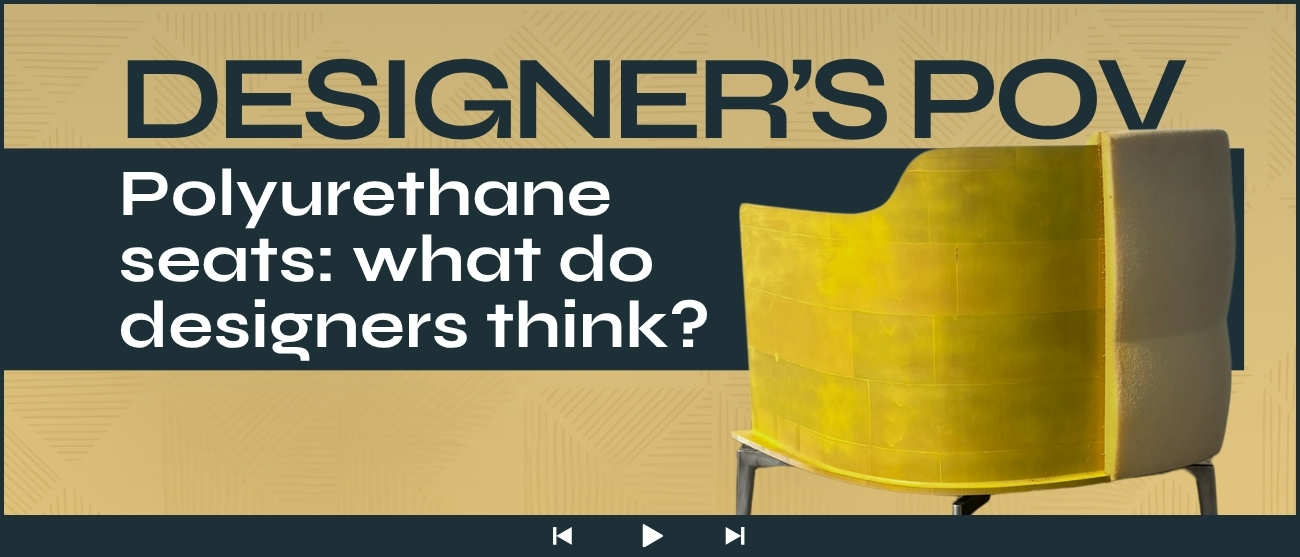
In the production chain of an upholstered seat, the person who is best placed to assess the quality of a shell is the person who upholsters it.
The upholstery department does not judge a render or a technical specification sheet; it judges the actual part on the workbench. And the actual part leaves no room for ambiguity. Either the upholstery can be stretched cleanly in a limited number of operations, or the cycle becomes longer due to manual adjustments, excess fabric that has to be recovered, edges that need to be forced into place, and staples that do not hold.
That additional time appears in neither the supplier’s quotation nor the cost of the fabric. It remains hidden, gradually eroding margins piece after piece, without anyone tracing it back to the decision made upstream.
Over many years of working on the development and production of seats, at Sititaly we have gained a valuable insight: in most cases, the defects that emerge at the workbench are already built into the geometry and construction of the shell, long before the fabric comes into play. They rarely depend on the quality of the fabric or on the upholsterer’s skill. The error is introduced during design, often unintentionally, and the upholstery stage simply reveals it.
The cause lies upstream, in the construction of the shell
In traditional seats, the structure brings together different materials, such as a metal or plywood frame, applied padding, and wooden strips for attaching the fabric.
Every interface between different materials is a potential critical point. The strips require manual stapling, with the risk that the upholstery will not adhere where it needs to and that tension will be uneven.
The edges of assembled structures struggle to maintain their shape under load, and on double-curved surfaces, shrinkage and rippling can appear only after the work is completed, when there is virtually no room left for correction.
There is also dimensional variability from one piece to another, typical of assembly-based processes. This forces the upholsterer to readjust their movements for each shell and undermines the repeatability that makes the cycle efficient.
The upholsterer is not the problem: that critical issue was already present in the shell before it ever reached the workbench.
What changes with a shell designed for the upholstery stage
Our approach starts precisely here. Moulded polyurethane shells are made as a single element, without added frames, without strips, and without joints between different materials. This eliminates a significant share of upholstery-related issues from the outset.
The advantage that the production department notices immediately, however, is a construction detail incorporated directly into the mould: the upholstery retention channel. It is a guide integrated into the shell geometry, designed so that the fabric can be positioned and secured in the correct place at the correct tension, without manual corrections.
The upholstery conforms to the seat instead of having to be forced into shape, making the cycle faster, the hold more uniform, fabric waste lower, and the aesthetic result more consistent from one piece to the next.
There are also several factors that may seem marginal on an individual seat but become decisive at production volumes:
- A polyurethane shell is structurally robust but significantly lighter than a traditional structure, making it easier to handle during movement and less tiring during repeated use throughout the shift.
- The shape remains stable because the edges hold their form and curved areas do not shrink. And because a single-piece moulded component is not prone to dents during packaging, the shell arriving at the workbench does not have defects that need to be concealed.
- Finally, there is dimensional repeatability, perhaps the least visible yet most tangible factor in terms of cost: every shell comes out of the mould identical to the previous one, allowing the upholsterer to work with a consistent method that reduces time and waste in a measurable way month after month.
The practical consequence is simple. The ability to work well, quickly, and consistently depends much more on the design of the shell than on the final stage of the process.
For this reason, when evaluating a production partner, the most reliable test does not involve comparing price lists or renders. Have the person who will actually upholster the product in the company upholster a sample shell, and measure how many operations are required, how long the cycle takes, and how consistent the finished piece is. In half an hour, you obtain information that no quotation can give you, because it addresses the most underestimated cost item in the entire production chain: processing time.
A well-designed seat is not defined solely by the aesthetics of the finished product. It is a seat that can be upholstered efficiently, that stabilises the department’s production times, and that comes out of production more refined and more consistent. At volumes of several hundred pieces per month, all of this translates into recovered margin.
If you want to quantify how much time and material you could save in upholstery with a properly designed shell, send us the model you currently produce and we will carry out a technical assessment, with the numbers to back it up, before even considering any modification.