From 2029 on, the European seating market will be regulated by legislation that introduces stringent requirements for durability, repairability and recyclability. The ESPR (Ecodesign for Sustainable Products Regulation), approved by the European Commission in July 2024, represents one of the pillarsof the Green Deal of the Circular Economy Action Plan.
The furniture field is among the priorities of the first Working Plan 2025-2030. According to the official timeline, the specific delegated regulation will be adopted in 2028, while effective implementation – that is, compliance for products placed on themarket – will start in 2029.
ESPR extends the scope of the previous Ecodesign Directive (2009/125/EC), which was limited to energy-related products. It now covers virtually all physical goods sold in the European Union, with a few exceptions regulated separately (foods, drugs, medical products).
The stated goal is twofold: to reduce the environmental impact ofproductsthroughout their life cycle and accelerate the transition towards a circular economy. For the furniture sector, this translates into five main areas of intervention.
The five pillars of compliance
1. Durability and repairability
Products should be designed to withstand time and to allow routine maintenance. The legislation aims to counter planned obsolescence and promote business models based on product longevity.
2. Recycled or bio-based content
The requirement for recycled or renewable material in materials such as polyurethane is estimated to be around 30%. Companies that rely exclusively on virgin fossil fuels will need to rethink their supply chains.
3. Separability of components
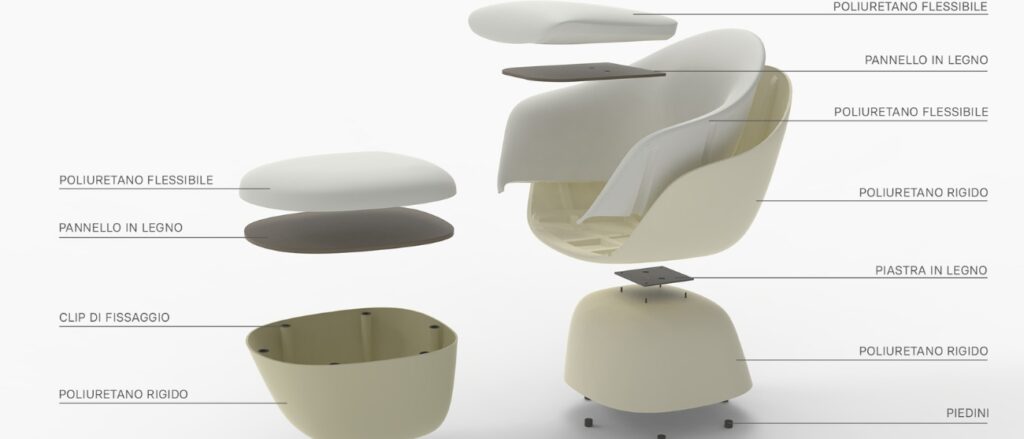
To enable selective recycling at the end of life, the design should facilitate the disassembly of different parts such as structure, padding, and cladding. Permanent assemblies with structural adhesives will no longer be compatible with the new standards.
4. Digital Product Passport (DPP)
Each product will be equipped with a “digital passport” containing information on material composition, origin, environmental impact, repair instructions and end-of-life. The system will ensure full traceability along the supply chain.
5. Minimum Environmental Criteria (CAM)
To participate in public tenders -contract, hospitality, office sectors – it will be mandatory todemonstrate compliance with CAM. Those who do not meet these criteria will automatically be excluded from the award procedures.
What happens to those who are not ready
The impact of legislation will not be uniform. Companies that already operate with circular logic will have an immediate competitive advantage. Those who continue to design according to linear models (production-use-disposal) will face significant adjustment costs.
The market surveillance authorities of the Member States will have the power to block the marketing of non-compliantproducts, to order recall and to impose sanctions. The legislation also provides for transparency obligations: companies will have to disclose the quantities of unsold products destroyed and the reasons.
For non-EU producers exporting to the EU market, the same rules will be applied without exception. The Commission has stated that it will carefully assess the implications for trading partners, but confirmed that there will be no exemptions.
How did Sititaly anticipate 2029?
At Sititaly, we have been operating in accordance with the principles that will become mandatory in 2029. Our decision to focus on molded polyurethane seats comes from the belief that this material, when combined with design intelligence, offers the needed attributes for a circular model: monomateriality, separability, durability, and repairability.
Take our IDA Lounge as an example. It has been designed with a completely reusable rigid polyurethane BIO 7R shell, a removable coating system without the use of glues, and a component that the end consumer can replace independently. This approach corresponds exactly to what ESPR requires in terms of design for disassembly and circular economy.
In terms of materials, we already supply bio-based polyurethane in different percentages: 7R as standard, 20R on request, and30R will be also available soon, anticipating future regulatory requirements. In parallel, we are working on LCA (Life Cycle Assessment) certifications for each of our product lines, with the aim of obtaining complete EPDs (Environmental Product Declaration) that guarantee maximum transparency on environmental impact.
We are not adapting to a regulation. We are building products that will be relevant and competitive when that legislation is fully in place.
Design today to sell tomorrow
There are three years left to prepare. Those who can anticipate will transform a constraint into an advantage. Those who wait risk being out of business.
We at Sititaly are ready to accompany you on this journey. Through our Sit With Us service, we support you in the co-design of chairs that already meet ESPR requirements: from concept stage to 3D mathematics, from prototyping to industrial production.
Contact us to design tomorrow’s session together.