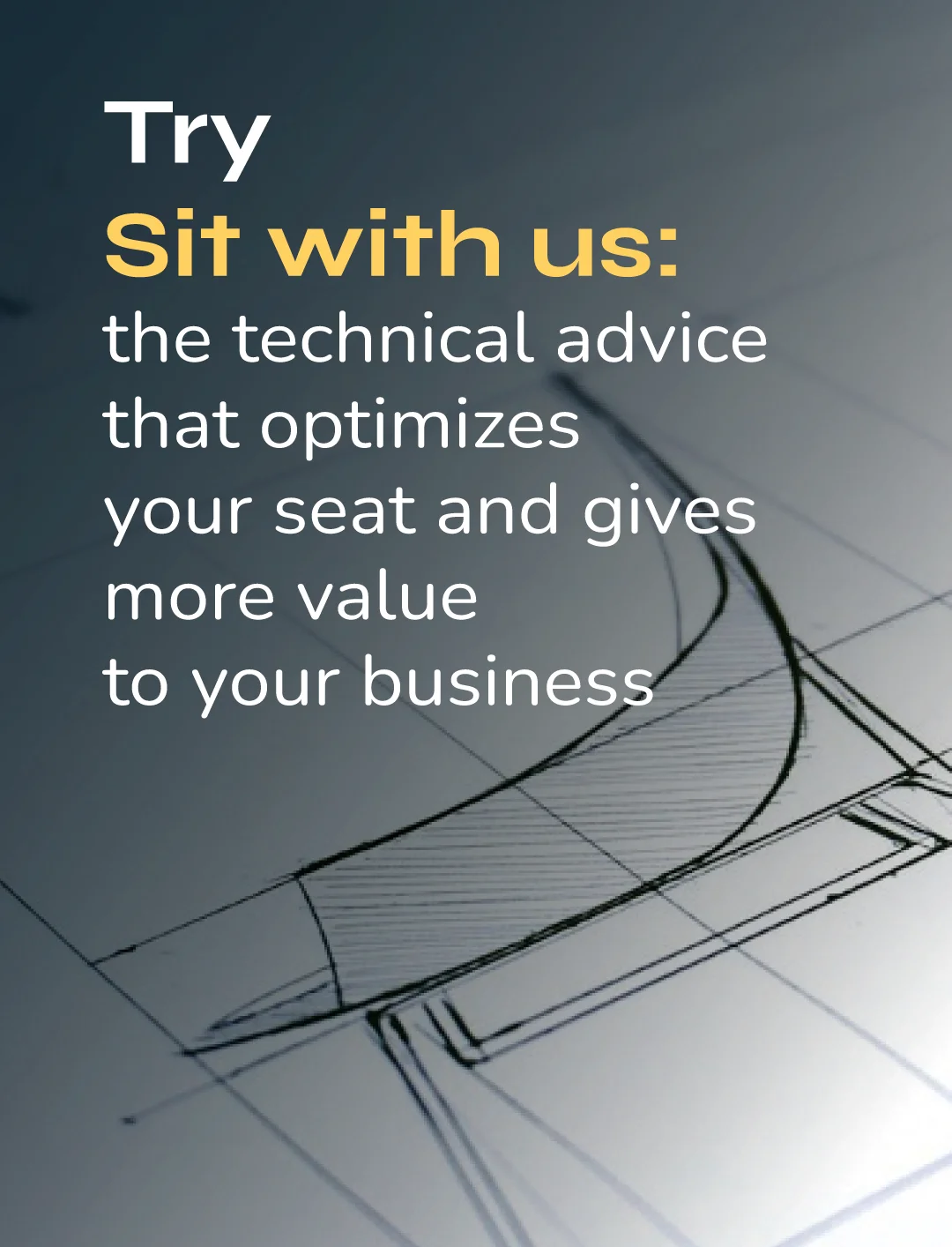
The story of a seating collection begins with a drawing, and from there a long journey unfolds, taking in the mould, production, upholstery and the variants the market will call for season after season. Yet almost everything that happens along the way is decided at the very beginning, when the seat exists only as a file.
Precisely because this is a stage when there is nothing to show yet, bringing a technical partner on board can seem like the most expensive item in the project budget, and an easy place to make savings. In fact, this is the stage at which that investment does the most work, because its benefits carry through to the six stages that follow. Each one is worth looking at in turn.
From drawing to mould: when mistakes can no longer be corrected
An American furniture manufacturer contacted us because the backrest of one of its armchairs was giving way. The same failure occurred on every piece coming off the production line, with such consistency that the cause clearly lay in the shape itself rather than in the manufacturing process.
Since a shell mould is made only once, if the error lies in the geometry, no amount of tweaking will fix it: the mould has to be remade from scratch, along with the samples and tests. In this case, the defect was caused by incorrectly designed ribs and unsuitable wall thicknesses. It was a deviation that could have been corrected on the drawing in half an hour, but once the mould was complete, it affected every piece right through to the end of production.
The mould determines how much material is needed
The mould does more than define the seat’s external shape. The shell thicknesses and the position of the ribs are already set in its cavity, so the amount of raw material used in each piece is determined at this stage and remains the same with every moulding cycle.
This is also where the absence of structural analysis becomes apparent. Without data on the loads involved, the only option is to increase wall thicknesses and position the ribs based on experience. It is a sensible precaution, but one that has to be paid for on every piece throughout the product’s commercial life.
We start with finite element analysis, which simulates the loads on the shell before it even exists, showing where the structure is doing useful work and where it is simply adding weight.For the Dalia armchair, this made it possible to reduce material use by 20% while maintaining the same structural strength, and to pass the CATAS tests at the first attempt, avoiding a second round of testing that would have used up samples and weeks of time.
The third cost emerges during upholstery
After production, the shell moves on to upholstery, where a cost no one had budgeted for can come to light. Geometry designed solely around appearance can make the fabric pull where it should not and add time to certain stages of the upholstery process. The difference may go unnoticed on a single item, but across an entire production run it becomes a significant problem.
One client’s project arose from precisely this difficulty. It had a supporting structure made from curved plywood, assembled by hand using plates and staples, in a process that made it difficult to ensure that any two pieces were truly identical. We redesigned it as a single shell in rigid polyurethane, incorporating the fabric channel directly into the mould so that the upholstery fits into place without the need for adjustments.
When a collection expands, modularity must already be built in
If a collection performs well, after a few seasons the market may ask for a version with a higher backrest or a variant for the contract market. That is when it becomes clear whether modularity was planned from the outset: if it was not, each new request means making another mould.
For DALIA, we worked with interchangeable inserts. Today, the standard and medium-back versions can be produced using the same tooling — an option that is only possible while the shape can still be modified.
Each model should have its material chosen individually
Variants raise a question that is often left off the table: is the material chosen for the first model also suitable for the others? Without a technical partner to consult, a manufacturer may choose a single material for the entire range, risking paying for performance a particular seat will never need, or discovering, once the mould has been made, that the original choice does not meet the specification.
Rigid polyurethane provides shape and structure, while flexible polyurethane delivers comfort and can be replaced separately at the end of the product’s life. The same reasoning applies to plant-derived content: BIO 7R is the standard formulation, while BIO 20R is used when a higher percentage needs to be declared.
End-of-life considerations are decided in the first drawing
The final cost arises when a product leaves the market and its materials need to be separated for recovery. If a metal frame has been moulded into the shell, the materials cannot be separated and the entire seat ends up in landfill. Whether recovery will be possible is decided in the mould, many years earlier.
That is why we work with self-supporting, single-material shells made from rigid polyurethane, without permanent structural adhesives and expanded using water. With IDA, the foam can be replaced without tools and without having to peel or prise anything apart.
The European Ecodesign Regulation was approved in 2024, with obligations expected to begin in 2029. This means that no one can currently claim compliance with a regulation whose requirements have not yet been fully written. What we can do, however, is design shells so that, when those rules come into force, there will be nothing to redesign.
Six stages, one decision point
The six stages take place at very different times, from mould-making to the recycling facility. What they all have in common is the point at which they are decided: the drawing. This is where a choice becomes a defining feature of the product.
That is why our work begins before a project is commissioned, following the same approach used for Micol Lounge R1, which received the Interzum Award 2024, and IDA, recognised with the Interzum Award 2025 for high product quality.
If you are developing a collection, Sit With Us is the service through which our technical team works alongside you while the design is still open to change. We assess the shell with all six stages in mind: the mould, the material required at full production scale, the upholstery process, the variants you may want to add, and what will happen to the seat when it leaves the market.
That discussion produces a list of improvements that are still possible — and that will remain with the product throughout its life. The consultancy is free of charge.